A Daily Devotional for Grief: 7 Free Days for Women
Grief does not keep office hours. It shows up in the grocery store, at 3am, in the middle of a normal Tuesday. If you are grieving someone you love, here are seven short devotionals you can read one a day, or all at once, or the same one over and over. Each one is built around a single verse, quoted word for word, with a short prayer and one question to sit with.
No email and nothing to sign up for. You do not have to read them in order, and you do not have to finish.
Before you start
- Read one a day, slowly. Five minutes is enough.
- If a day does not fit where you are, skip it. Grief is not a straight line.
- Say the prayer out loud if you can, or just read it. Both count.
A gentle 4-week study for grief
Ten minutes a day with the places in Scripture where God meets grieving people. No rush, no fixing, just company.
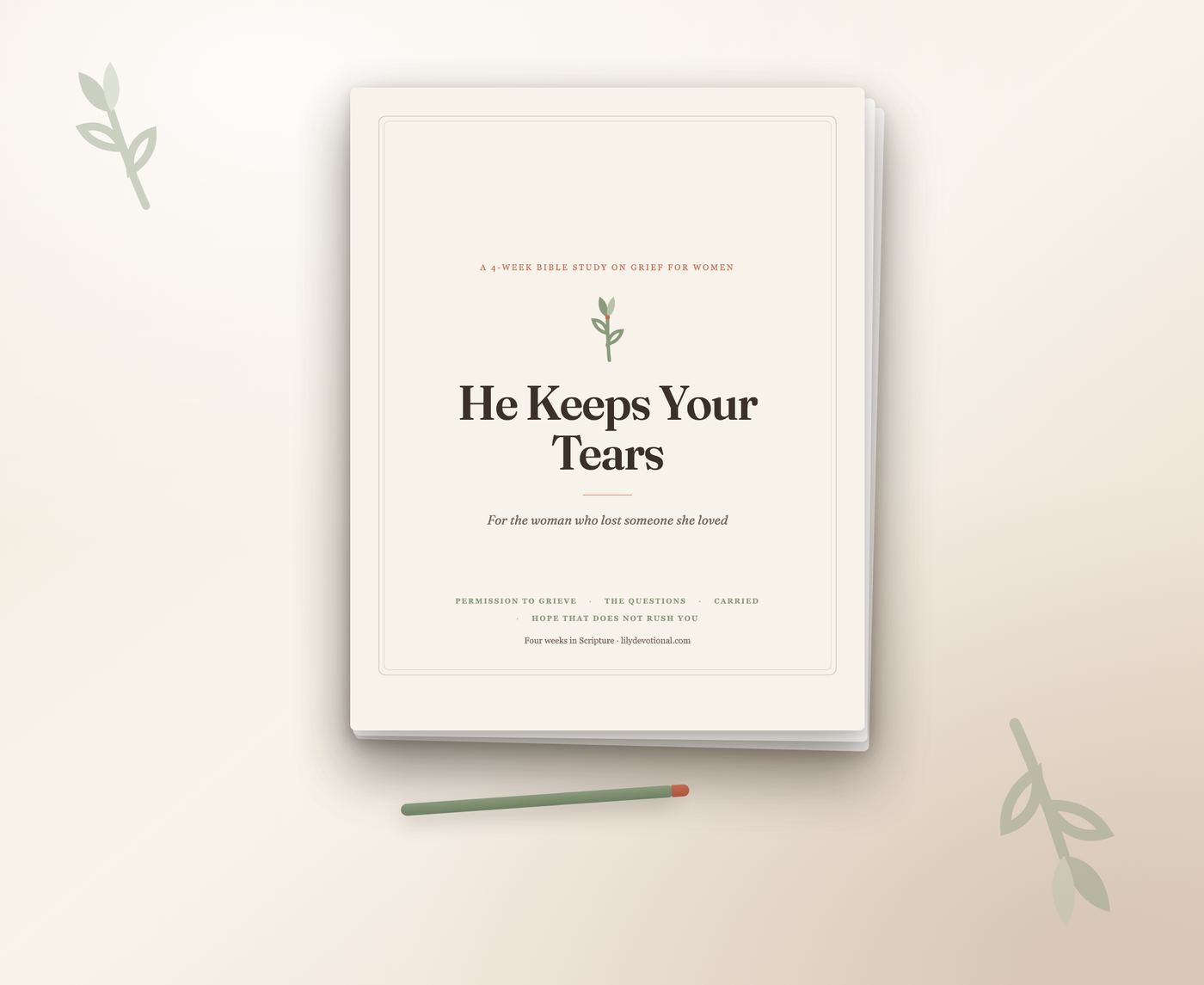
Not ready to buy? Start with A scripture plan for grief, free. Instant PDF, yours forever, 30-day refund.
Day 1
Jesus Cried Too
There is a story in the Bible that we want to hand you today, gently, like a warm cup of coffee across the table.
Jesus had a friend named Lazarus who died. When Jesus arrived at the town, Lazarus had already been in the tomb four days. His sisters were crying. Their friends were crying. And here is the part that stops us every time: Jesus knew how the story would end. He knew what he was about to do. And he still cried.
“When Jesus saw her weeping, and the Jews who had come with her also weeping, He was deeply moved in spirit and troubled. “Where have you put him?” He asked. “Come and see, Lord,” they answered. Jesus wept.”
John 11:33-35 (BSB)
The shortest verse in the Bible is simply about Jesus crying. Think about that. God, standing in a human body, with tears running down his face at a graveside. He did not tell the sisters to cheer up. He did not explain the loss to them. He did not say it happened for a reason. He stood with them in it, and he wept.
So if anyone has made you feel that crying means your faith is small, friend, let this story quietly answer them. Tears are not a lack of faith. Tears were on the face of Jesus himself. Crying is not falling apart. Sometimes it is the most honest prayer we have.
Maybe today is a day when the tears are right at the surface. You don't have to push them down. You can cry in the shower, in the car, into a pillow, in the middle of folding laundry. There is no wrong place. The One who wept at his friend's tomb is not embarrassed by your tears. He understands them from the inside.
Today's invitation is simple: if the tears come, let them. You are in very good company.
Reflect: What would it feel like to let yourself cry today without judging yourself for it?
Day 2
When You Have No Words
Some mornings, prayer feels impossible. You open your mouth, or your journal, or your heart, and nothing comes. Just a blank. Or a groan. Or one tired sentence: God, I can't.
If that is where you are, we have good news that feels almost too kind to be true. The Bible says that when we are weak and don't know what to pray, the Holy Spirit steps in and prays for us. Not with polished words. Paul describes it as something deeper than words, like groans that carry what we cannot say.
“In the same way, the Spirit helps us in our weakness. For we do not know how we ought to pray, but the Spirit Himself intercedes for us with groans too deep for words.”
Romans 8:26 (BSB)
Read that slowly when you tap on it. It means the pressure is off. Prayer, in a season like this one, is not a performance you have to get right. It is more like collapsing into a chair in a room where Someone already knows. When all you can manage is a sigh from the couch, you are not praying alone. The Spirit is already at work in that room, doing the part you cannot do.
We sometimes imagine God waiting for us to compose ourselves, to come back when we can speak in full sentences. The picture Scripture gives is the opposite. In our weakest hour, God is not waiting at a distance. He is participating. He is inside the prayer with us, carrying the words we cannot find.
So today, friend, let your prayer be as small as it needs to be. A single word. A held breath. Tears with no caption. You do not have to make it bigger before you offer it. Paul's picture of prayer has room for a person who has run out of words, and that room was built for days like this one.
Reflect: What is the one small word or sigh your heart would offer God today?
Day 3
Walking Through the Valley
A week ago we started this journey together, and we want to pause and say: you have made it through seven days. That is not nothing. Some of those days probably felt like years.
Today, let's walk into the most famous psalm in the world, but slowly, because grief hears it differently. David wrote about God as a shepherd, and right in the middle of the psalm, the scenery changes. Green fields and quiet water give way to a dark valley, the kind where death casts its shadow over everything.
“Even though I walk through the valley of the shadow of death, I will fear no evil, for You are with me; Your rod and Your staff, they comfort me.”
Psalms 23:4 (BSB)
Here is what we notice when we read it in a season like yours. First, the valley is on the shepherd's route. It is not a wrong turn. Godly people, well-loved sheep, still walk through places this dark. Being in the valley does not mean you wandered off or did something wrong.
Second, honesty about the word through. It comes with no map and no schedule. Nobody can tell you how long this valley runs, and some of this loss may walk with you for a long while. The psalm does not hand out dates, and neither will we. What it refuses to say is that any sheep walks this dark stretch by itself.
Third, and most important: the psalm says the reason not to be overcome by fear in that valley is simple presence. Not answers. Not a map. Not a schedule. With me. The shepherd does not send the sheep through the dark alone and wave from the hilltop.
Friend, that is where you are: in the valley, yes, but accompanied. Every step of it, even the steps you take crying, even the days you sit down in the middle of the path and can't move. He stays.
Reflect: What is one small sign, today, that you have not been walking this valley alone?
Day 4
You Can Be Honest with God
Can we talk about the feelings you might be hiding? The ones you think a good Christian woman shouldn't have. The anger. The why questions. The moments you have wondered where God even was.
Here is what many of us were never told: the Bible is full of people saying exactly those things, out loud, to God's face. David opens one psalm with questions most of us would be afraid to pray out loud.
“For the choirmaster. A Psalm of David. How long, O LORD? Will You forget me forever? How long will You hide Your face from me? How long must I wrestle in my soul, with sorrow in my heart each day? How long will my enemy dominate me?”
Psalms 13:1-2 (BSB)
And God did not strike that psalm from the record. He kept it. He made it part of Scripture, which means he made room, forever, for prayers that start with frustration and hurt. The psalms teach us that honesty is not the opposite of faith. Honesty aimed at God is faith. You have to believe Someone is listening to bother yelling at the ceiling.
David also wrote about pouring out our hearts to God like water from a pitcher, holding nothing back, because God is a safe place for the whole mess.
“Trust in Him at all times, O people; pour out your hearts before Him. God is our refuge. Selah”
Psalms 62:8 (BSB)
So, friend, if there is anger in you, bring it. If there are questions with sharp edges, bring them. God is not fragile, and he is not offended by grief telling the truth. He would rather have your real, ragged prayers than your polite silence. The people who felt free to argue with God in Scripture were usually the ones who knew him best.
You will not lose him by being honest. You might just find him closer than ever, right there in the middle of the hardest sentence you've ever prayed.
Reflect: What is one honest sentence you have been holding back from God, and can you say it to him today?
Day 5
Grief Comes in Waves
Maybe you have noticed the pattern by now. A few steadier hours, maybe even a decent day, and then a wave rises out of nowhere and knocks you flat again. Then it recedes. Then it returns. If you were hoping grief would be a staircase, one step better every day, the waves can feel like failure. They are not. This is simply how grief moves. Like the sea, not like stairs.
The Bible never pretends life runs in a straight line. The book of Ecclesiastes says plainly that life on this earth comes in seasons, and it names them without flinching, the heavy ones printed right beside the light ones:
“To everything there is a season, and a time for every purpose under heaven: a time to be born and a time to die, a time to plant and a time to uproot, a time to kill and a time to heal, a time to break down and a time to build, a time to weep and a time to laugh, a time to mourn and a time to dance,”
Ecclesiastes 3:1-4 (BSB)
Notice that weeping and mourning get their own appointed place. They are not interruptions to real life. They are part of real life, and God is not surprised or disappointed when your calendar is full of them right now.
And notice something else, gently: nobody can tell you the length of a season. Not us, not your relatives, not the voice in your head that says you should be further along. Seasons don't take orders.
So here is a kinder way to ride the waves. When a good hour comes, receive it without guilt; it is not a betrayal of what you lost. When a wave hits, let it move through without shame; it is not a relapse. You are not doing grief wrong, friend. You are in a weeping season, held by a God who honors weeping seasons, and he rides every wave with you.
Reflect: When the last wave hit, what helped even a little, and could you keep that close for the next one?
Day 6
No Deadline on Your Grief
Somewhere around this point, the outside world starts checking its watch. The casseroles stop. The texts thin out. Someone asks, with kind eyes, whether you're feeling more like yourself. And a quiet pressure creeps in: shouldn't I be over this by now?
Let's say it clearly, friend: there is no deadline on grief. Not thirty days, not a year, not any number anyone gives you. Love does not run on a schedule, so the missing doesn't either. The people who set timelines for other people's sorrow have usually never carried a sorrow like yours.
David, in a psalm written from a frightening and painful stretch of life, made a beautiful move. He took all the unknowns of his future and placed them somewhere safe. He said his trust was in God, and that his times, all his days and seasons, rested in God's hands.
“But I trust in You, O LORD; I say, “You are my God.” My times are in Your hands; deliver me from my enemies and from those who pursue me.”
Psalms 31:14-15 (BSB)
Your times are in those same hands. That includes your healing, however slowly it comes, and in whatever order. It includes the days you function well and the days you don't. It includes the parts of you that may always carry this loss, because some losses are not gotten over; they are woven in, and we learn, slowly, to live with the weight.
God is not standing over you with a stopwatch. He is sitting beside you with open hands. He has never once looked at a grieving daughter and said, too slow.
So when the pressure comes, from others or from inside your own head, you can answer it gently: the timing of my life rests in God's hands. Not the calendar's. Not anyone else's. His. And his hands are patient.
Reflect: Where have you been feeling rushed in your grief, and what would it mean to hand that timeline to God?
Day 7
The Slow Work of Mending
Picture a careful nurse wrapping a wound. She doesn't slap the bandage on and walk away. She cleans the hurt place gently, covers it, checks on it, changes the dressing, gives it time. Healing, done right, is slow and tender and repeated.
That is the picture the Bible uses for what God does with people like us:
“He heals the brokenhearted and binds up their wounds.”
Psalms 147:3 (BSB)
Binding up a wound is slow work. It is close work. You cannot bandage someone from across the room. The God who runs the whole universe is also the God kneeling beside you, doing quiet, careful wound care on your heart.
Notice what the verse does not say. It does not say he heals instantly. Broken hearts are not light switches, and God does not treat them like repairs to rush. He treats them like wounds to tend: gently, repeatedly, for as long as they take. Some days you may feel the mending. Many days you will feel nothing except sore. That does not mean the tending has stopped. Wounds heal mostly in secret, under the bandage, while we sleep.
Your part is not to speed it up. You cannot, and you were never asked to. Your part is to stay under his care: keep showing up in these quiet minutes, keep telling him the truth, keep letting people in, keep eating and resting and breathing. Patients don't heal themselves. They cooperate with the healer.
However long this takes is however long it takes. There is no falling behind, because there was never a schedule. The bandages are fresh every morning, and the Healer does not give up on hearts in his care.
Reflect: What is one way you could cooperate with God's slow healing this week?
If it is more than sadness
Grief can go darker than sadness. If you are having thoughts of harming yourself, please tell someone today. In the US you can call or text 988 at any hour. A grief counselor, your pastor, or a group of people who have lost someone too is not a shortcut around faith. It is company for a long road.
When seven days is not enough
For a slow way to keep going, the free grief scripture writing plan gives you one verse a day to copy by hand. If you want to go deeper, He Keeps Your Tears is a gentle 4-week grief Bible study for women, with no timeline and no tidy answers. If your loss is a specific person, these pages were written for it: losing a husband, losing a child, and grief at Christmas.
If you want to keep going
A study for the grieving season that does not rush you, built on the Psalms of lament, John 11, Job and Romans 8.
Instant download, no account, yours forever. Free first: the grief scripture writing plan.
Questions women ask
What is a good daily devotional for grief?
A good grief devotional is short, honest, and does not rush you. Look for one that quotes Scripture word for word, lets you be sad without fixing you, and gives you a simple prayer for the day. This page has seven free days you can read in any order.
What Bible verses help with grief?
Psalm 34:18 (the LORD is near to the brokenhearted), John 11:35 (Jesus wept), Psalm 23:4, Psalm 62:8, Romans 8:26, and Psalm 147:3 are some of the verses grieving women return to most. Each day on this page is built around one of them.
How long should I read a devotional on grief?
As long as it helps. Some women read one a day, some read the same day three times. There is no schedule for grief and no schedule for this page.
Is it okay to be angry with God when I am grieving?
The Psalms are full of honest, angry prayers, and God kept them in the Bible. Telling God how you really feel is a form of trust, not a lack of it.
Keep going
A companion for the grieving season, every morning
Lily is a daily devotional app for women, free on iPhone. A short devotional for your exact season every morning, Bible answers any hour, and a place to watch God answer your prayers.
Get Lily free on the App Store
Free daily devotional. No ads. No account.